 EN
EN  IT
IT  FR
FR 
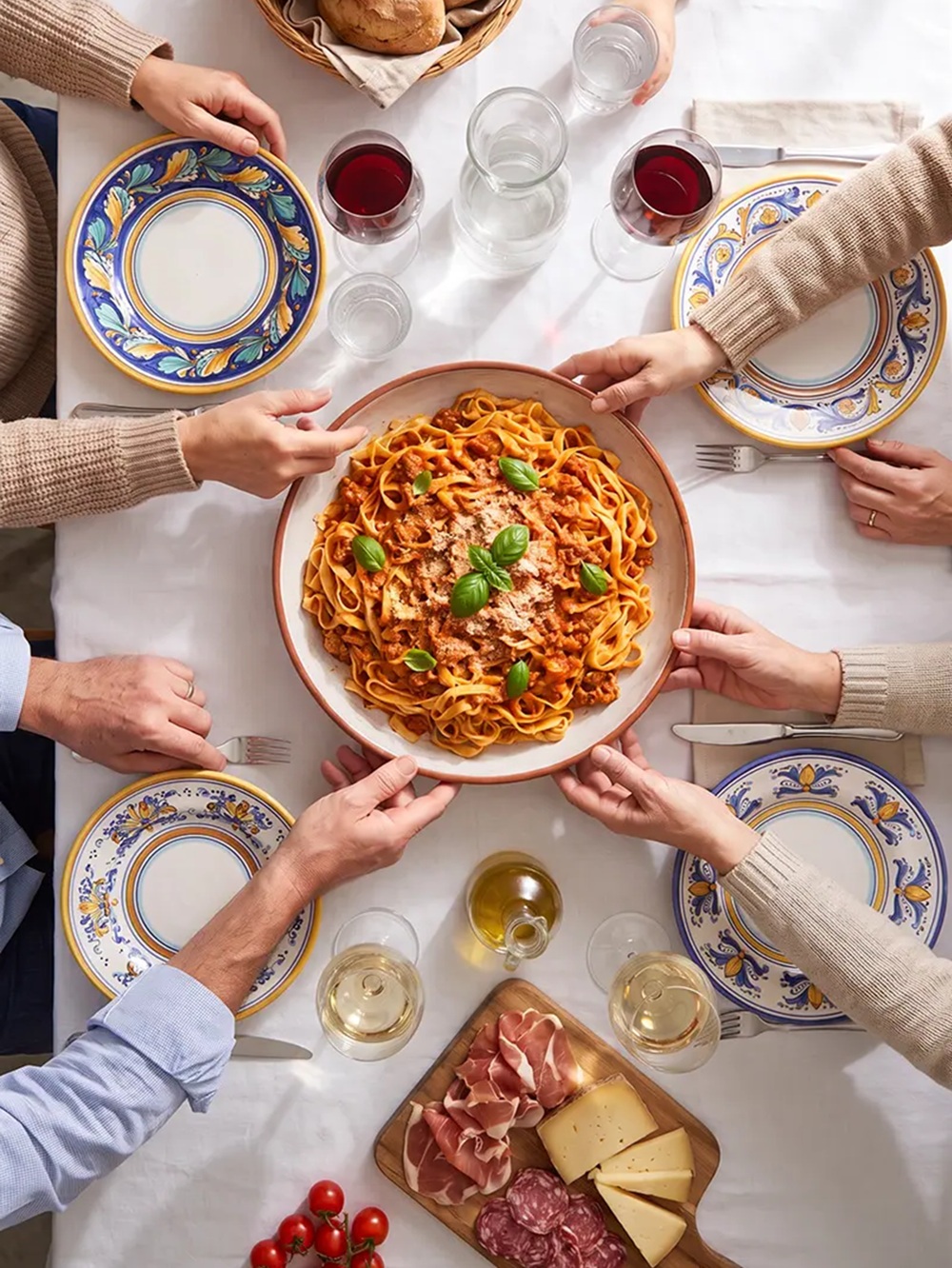
To understand why the table holds such a special place in the Italian art of living, Giulia from Itinerari Blog invites us to trace the thread of history, from Boccaccio to UNESCO, and discover a sense of conviviality deeply rooted in Italian culture.
Table of Contents
From Boccaccio to UNESCO, the art of the table and the art of living are closely intertwined in Italy.
If UNESCO decided to include Italian cuisine on the “Representative List of the Intangible Cultural Heritage of Humanity,” it is because it has unique characteristics. The emphasis is certainly placed on “the use of raw ingredients and traditional food preparation techniques,” but there is another aspect of equal importance.
The second pillar behind this decision is indeed: “It is a communal activity that emphasizes intimacy with food, respect for ingredients, and moments shared around the table.”
Conviviality is therefore one of the key elements of Italian food culture and represents a fundamental pillar of Italian culture as a whole.
Boccaccio Was Already Writing About Conviviality in the Middle Ages
We can go far back in history to find traces of this approach to food and gastronomy. It is already an important theme in the work of Boccaccio. As Giulia Parma, postdoctoral researcher within the ERC AGRELITA project at the University of Caen Normandy, explains, “many of the stories in the Decameron describe scenes of meals, often shared meals, or cooking…
The members of the “brigata” (group) who tell and listen to the stories also devote themselves to this activity every day during the ten days of their stay in the countryside around Florence...They have the difficult task of rebuilding a healthy and orderly society, thus providing a model of a happy and balanced life...In this sense, the food and drinks accompanying their meals, always consumed in moderation, form a regimen, one of those earthly remedies that can lead to healing through pleasure.”
The table as a place of healing, yet also an essential part of everyday life. Conviviality as a moment of connection, exchange, and physical and mental well-being.
We are not far from UNESCO's description: “This practice thus fosters social inclusion while promoting well-being and providing a channel for lifelong and intergenerational learning.”
The Table as a Place for Connection and Exchange
Historically, this dimension of food as a privileged moment for connection and interpersonal exchange has always been present in the everyday reality of the Italian table.
Even today, inviting friends over for dinner is an important social occasion in Italy, even though preparations have become simpler and table settings less formal. What remains constant is the desire to welcome the people we love into our homes and give them a wonderful time together.
From Rossini to Camilleri, Art and the Art of the Table Go Hand in Hand
As the great musician Gioacchino Rossini once said: “Eating, loving, singing, and digesting are the four acts of that comic opera which is life.”
In his book La scienza in cucina e l'arte di mangiar bene: igiene, economia, buon gusto (Science in the Kitchen and the Art of Eating Well: Hygiene, Economy, Good Taste), Pellegrino Artusi gives an important place to conviviality. His book has long been considered a cornerstone of Italian culinary literature, with particular attention to traditional family cooking. And it is no coincidence that he wrote: “The best sauce you can offer your guests is a pleasant face and sincere cordiality.” That is certainly not the sentence you would expect to introduce sauce recipes in a cookbook!
To quote Andrea Camilleri, who, in addition to loving writing, also had a passion for gastronomy: “Our historic duty is to know how to be together at the table. It is not enough to eat: peace means eating with others.”
The Slow Food Movement
It is therefore no coincidence that the Slow Food movement was born in Italy in 1989, on the initiative of Carlo Petrini, with its manifesto titled “Good, Clean and Fair.” Time, respect for the environment and health, and human relationships: everything is reflected in Slow Food’s work.
It is therefore possible to say that, from antiquity to the present day, conviviality has been an essential part of the Italian art of living. Around the table, of course, we can eat, but we can also talk, share, and even argue! Everything that is part of human relationships finds its place around the table. And preferably around a family table that is welcoming and warm.
Resources
A cultural and social fusion centered around food traditions, this element is associated with the use of raw ingredients and traditional techniques for preparing food. It is a shared activity that emphasizes a close relationship with food, respect for ingredients, and moments spent together around the table. This practice draws on recipes designed to reduce food waste and on the transmission of flavors, knowledge, skills, and memories from one generation to the next. It is a way of bringing families and communities closer together, whether at home, at school, or during festivals, ceremonies, and social gatherings. People of all ages and genders take part, exchanging recipes, suggestions, and stories, with grandparents often passing traditional family recipes down to their grandchildren. The knowledge and skills associated with this element are transmitted informally within families and formally in schools and universities.
Beyond cooking, practitioners consider this element a way to care for themselves and others, express love, and rediscover their cultural roots. It allows communities to share their history and describe the world around them. It also contributes to preserving specific cultural expressions, such as language and gestures. The practice therefore promotes social inclusion while supporting well-being and providing a channel for lifelong and intergenerational learning. It also strengthens relationships, encourages sharing, and fosters a sense of belonging.
“The best sauce you can offer your guests is a pleasant face and sincere cordiality. At lunch, which is the main meal of the day and, I would say, almost a family celebration…”
“Eating, loving, singing, and digesting are the four acts of that comic opera which is life.”
“Our historic duty is to know how to be together at the table. It is not enough to eat: peace means eating with others.”
Read also: The Art of Italian Entertaining: The Complete Guide to Creating Unforgettable Dinner Parties


Let’s talk together!