 EN
 FR


You love cooking and enjoy hosting family and friends, but do you sometimes feel that your dinner parties are becoming a little too predictable? The meal is a success, everyone enjoys the food, your guests have a wonderful time… and yet, something may still be missing. A thoughtful touch, a certain atmosphere that turns an ordinary evening into a memory worth sharing.
Because hosting is about much more than preparing a good meal. It's also about thinking through the welcome, creating the right atmosphere, finding a natural rhythm and making sure everyone feels comfortable from the moment they arrive. Together, these little details give a dinner party an entirely different dimension.
Picture your guests arriving. The door opens, you greet them with a warm smile and offer them a first drink. Soft music fills the house as conversations begin to unfold. Wonderful aromas drift from the kitchen, the table is set and the atmosphere invites everyone to slow down and enjoy the moment. Gradually, conversations become livelier, the food makes its way to the table and the evening unfolds so naturally that no one feels the need to check the time.
What you've just created goes far beyond a successful meal. It's an experience in which every detail adds to the pleasure of being together. And that's exactly what we'll explore in this article: how to turn a dinner party at home into a truly Italian experience, without stress or unnecessary staging, but with a thoughtful approach to the Art of hosting.
Because true elegance isn't about impressing your guests at all costs. It's about creating a welcoming atmosphere, anticipating the little things that make people feel special and making sure everyone feels at ease. It's a generous, authentic approach to hospitality, one that leaves just as much room for spontaneity as it does for thoughtful preparation.
Free Guide: 10 Golden Rules for Hosting Italian-Style
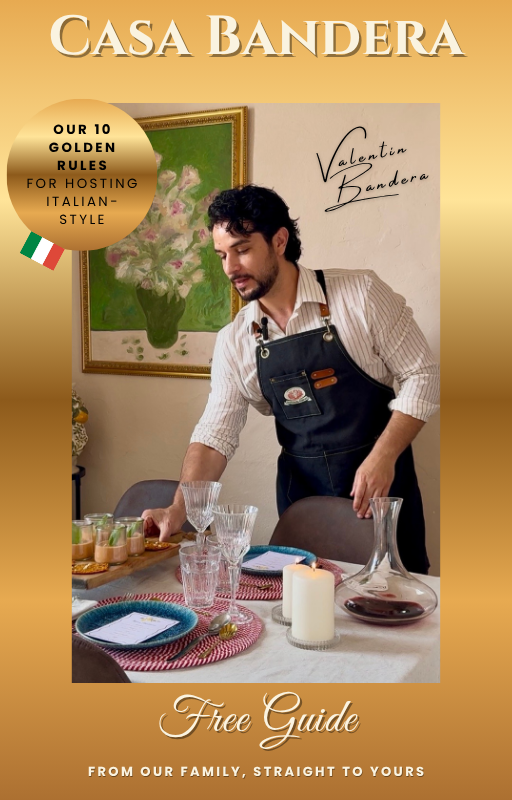

“In Italy, we remember more than just what we ate. We remember the atmosphere, the conversations and the moments shared around the table.”
— Casa Bandera, from our Famiglia to yours
Table of Contents
Why Some Dinner Parties Stay with Us… While Others Fade Away
We've all been to a dinner party where the food was exceptional, the ingredients carefully selected and every plate beautifully presented, yet somehow, we don't remember much about the evening itself. On the other hand, some much simpler meals stay with us for years. We remember an unexpected conversation, a burst of laughter, a bottle of wine we discovered together or that wonderful feeling of losing track of time.
The difference often comes down to the overall experience. The quality of the food certainly matters, but it's not enough on its own to make an evening truly memorable. The welcome, your guests' comfort, the atmosphere of the room and the freedom to simply enjoy the moment all play an equally important role. Together, these elements give a dinner party its sense of harmony.
I've often experienced this philosophy in Bologna, around long, crowded tables where conversations seemed to go on forever. There was no need for an elaborate menu or restaurant-worthy presentation on every plate. The food was generous, bottles were passed around and everyone naturally found their place in the conversation. What mattered most was something else entirely: the joy of coming together and making the most of our time around the table.
This is an important distinction when hosting at home. If all your attention is focused on preparing the food, you risk experiencing your dinner party as a succession of tasks to get through. But when you also think about welcoming your guests, the flow of the evening and their comfort, your entire perspective changes. Cooking becomes one part of the experience, rather than its sole purpose.
The Italian Secret: Think Experience, Not Just Dinner

In the world of Italian hospitality, food takes center stage, but it's only one part of what happens around the table. Planning an Italian dinner party also means thinking about how your guests will be welcomed, the atmosphere you want to create and the rhythm you want the evening to follow.
This approach fundamentally changes the way you prepare for a dinner party. Instead of focusing solely on the number of courses, recipes and cooking times, you can start by imagining the experience from your guests' perspective: What will they discover when they arrive? Where will they enjoy their first drink? How will you transition from aperitivo to dinner? What moments do you want to share with them? These questions help you create a thoughtfully paced evening in which every moment flows naturally into the next.
I grew up surrounded by this appreciation for shared moments. My Nonna never thought of a meal as simply a list of dishes to prepare. Of course, there were the recipes, the ingredients and the care she put into cooking, but there was also everything that brought the meal to life: the welcome, the conversations, the beautifully set table and the pleasure of having the whole family together. Without ever needing to explain it, she knew how to set the rhythm of an evening and make everyone feel expected and welcome.
This kind of hospitality doesn't rely on elaborate staging or sophisticated arrangements. Above all, it calls for thoughtfulness and a little planning ahead. Preparing a few things in advance, choosing the right atmosphere, having an aperitivo that's easy to serve and avoiding spending the entire evening in the kitchen: these are the kinds of decisions that allow you to genuinely enjoy your guests' company.
So your goal isn't simply to serve your guests a good meal. It's to create a moment where the food, the decor, the music and the conversations come together effortlessly. This bigger-picture approach is what gives the Italian Art of hosting its true meaning.
What a Truly Memorable Italian Experience Looks Like
Imagine an evening with friends. Your guests arrive, and you welcome them at your own pace, without having to step away to deal with last-minute preparations. The first drink is ready to be served, a few antipasti are arranged on the table, and soft music accompanies the first conversations. The lighting is just right, your home feels inviting, and the final preparations don't keep you from enjoying the moment.
After aperitivo, everyone gradually makes their way to the table. Each course is served at just the right moment, conversations flow naturally, and everyone takes the time to savor what's being served. You don't need to keep an eye on every detail of the dinner. The main stages have already been planned, giving you the freedom to spend time with your guests. If the evening runs a little longer because a conversation goes on, that's perfectly fine. The plan is there to guide you, not to dictate the pace of the evening.
As the evening unfolds, the practical details gradually fade into the background. What really matters is that your guests feel comfortable, can help themselves easily, enjoy lively conversations, and appreciate your company. You may even find that the best moments are the ones you never planned: a story that makes everyone around the table laugh, a bottle that sparks someone's curiosity, or a conversation that carries on long after dessert.
A successful evening doesn't mean everything has to be perfectly orchestrated. It's about finding the right balance between preparation and spontaneity. You take care of the details beforehand, then leave enough room for life to unfold so the evening can take its own natural course.
And when your guests leave feeling they've truly enjoyed themselves, you know you've given them much more than just a dinner. You've created a warm, welcoming experience filled with good food, meaningful moments, and shared memories. That's ultimately the beauty of the Italian Art of hosting.
The Atmosphere: What Your Guests Feel Before They Even Take a Bite

When a guest walks through your front door, they discover much more than a beautifully set table or a thoughtfully prepared menu. They step into a world you've created especially for the occasion. The lighting, the aromas drifting from the kitchen, the music playing softly in the background, and above all, the way you welcome them all help set the tone for the evening from the very first moment.
I've often seen this same attention to detail in my Nonna's home. Welcoming guests was never simply about inviting everyone to sit down at the table. There was time to greet each other, offer something to drink, and start chatting. In a way, the meal had already begun long before the first plates arrived. This transition between welcoming guests and sitting down to dinner allowed everyone to settle in and feel at ease, without feeling as though they had to follow a strict schedule.
Lighting plays a major role in that first impression. For an evening dinner party, choose soft, warm lighting rather than harsh, direct white light. A few table lamps, thoughtfully placed candles, or indirect lighting can be enough to make a room feel more inviting. The goal isn't to plunge the room into darkness, but to create a pleasant atmosphere where everyone can see each other and appreciate the food.
Music deserves the same attention. An instrumental playlist, a few jazz tracks, or a selection of Italian songs can provide the perfect backdrop for those first conversations. Just remember to keep the volume low: music should enhance the atmosphere, not become the center of attention. You can prepare your playlist before your guests arrive, so you won't have to think about it during the evening.
But there's one element we sometimes overlook: being present. If you're welcoming guests while rushing between the kitchen and living room, still worrying about the final preparations, they may pick up on that sense of urgency. On the other hand, when you've planned the important details ahead of time and can take the time to welcome everyone properly, the atmosphere naturally becomes more relaxed.
I particularly think of those moments at home when Mae is setting the table while Rose plays and runs around us. Not everything is always perfectly in order, and that's perfectly fine. There's life, conversation, and the occasional unexpected moment that comes with everyday family life. That spontaneity reminds me that hospitality doesn't require a spotless home or military-style organization. It begins, above all, with the pleasure of sharing your space with the people you love.
If you'd like to explore the visual side of hosting a dinner party, take a look at our tips on how to set a beautiful Italian-inspired table. Table styling and the overall atmosphere go hand in hand, giving your evening its own identity from the very first moment.
Free Guide: 10 Golden Rules for Hosting Italian-Style
The Flow of Dinner: The Invisible Element That Changes Everything
We often spend a great deal of time choosing recipes, preparing ingredients, and deciding how to present each dish. Yet there's another question worth thinking about in advance: what kind of rhythm do you want your dinner party to have? An enjoyable meal isn't just about what you serve, but also about how each part of the evening flows into the next.
In many Italian families, mealtimes leave plenty of room for conversation. Aperitivo gives everyone a chance to reconnect and settle in, antipasti whet the appetite, and then come the courses that shape the dinner. Between each stage, there's time to chat, clear the table, and enjoy one another's company. It's not about following a rigid ritual, but about allowing enough breathing room so the evening doesn't feel like a succession of courses being served one after another.
In Bologna, I remember dinners with friends that could easily last several hours. Nobody seemed in a hurry to move on to the next course. A conversation might continue while everyone finished their food, then another bottle of wine or a dessert would naturally bring everyone back together. Time was part of the pleasure, rather than another constraint to manage.
When hosting dinner at home, you can recreate that same effortless flow by avoiding the temptation to serve every course too quickly. Plan natural transitions between aperitivo, the different courses, and dessert. This doesn't mean leaving your guests waiting unnecessarily, but rather giving them time to finish at their own pace, enjoy the conversation, and make the most of each moment.
Preparation beforehand plays an essential role here. When you know your cooking times, have certain elements ready in advance, and have organized your time in the kitchen, you can adjust the pace without losing track of the evening. A complete Italian dinner menu doesn't necessarily require serving a large number of courses. It's really about finding the right balance between a generous menu, the time you have available, and the pleasure of hosting.
Finally, pay attention to your guests. Some people love long dinners that stretch late into the evening, while others prefer a shorter meal. The important thing is not to impose a pace simply because that's what you had planned. A well-paced evening should always remain flexible enough to adapt to the people gathered around your table.
Conversation: Turning a Meal into a Shared Experience

You can set a beautiful table and serve a perfectly executed menu, but if everyone stays in their own corner, something essential to the pleasure of hosting is missing: conversation. Good conversation brings a meal to life. It gives guests a chance to get to know one another, share memories and sometimes discover unexpected things they have in common.
At the family gatherings I experienced in Italy, conversation naturally played an important role. My Nonna sometimes had a way of asking the simplest question, enough to get everyone talking around the table. One person would share a memory, another would offer their perspective, and before long, everyone was part of the conversation. There was no need to organize games or prepare discussion topics in advance.
You can encourage these moments of connection with a few thoughtful gestures of your own. Introduce guests who haven't met before, briefly share the story behind a dish or tell an anecdote about a bottle of wine you've chosen. These little conversation starters help get things flowing without making it feel as though you're directing the evening.
You can also ask open-ended questions that invite people to share an experience rather than simply answer yes or no. A memorable trip, a culinary discovery, a vacation memory or a favorite local spot are all wonderful ways to get a conversation going. Just remember to leave room for spontaneity. There's no need to fill every silence or make everyone participate at all costs.
Your role is simply to create the right conditions for enjoyable conversation. Avoid dominating the discussion, make sure everyone has a chance to feel included and let conversations unfold naturally. This is especially important when several guests are meeting for the first time. Sometimes, a small gesture of attention from you is all it takes to help everyone feel at ease.
Ultimately, a welcoming atmosphere can't be forced. It grows through small interactions, genuine listening and the pleasure of getting to know others. Food brings everyone together around the table, but it's the conversations that often give the evening its true richness.
The Little Details That Make a Lasting Impression
When planning a dinner party, certain gestures may seem insignificant at first. Yet sometimes, they're precisely what makes your guests feel genuinely welcome. Offering them a drink as soon as they arrive, choosing seats with everyone's personalities and connections in mind, or preparing a dish with a loved one's tastes in mind: these thoughtful gestures show that you've taken the time to think about the people you're welcoming into your home.
It might also be something a little more personal. A bottle brought back from a trip, a regional specialty you'd like your guests to discover or a dessert that brings back a shared memory. By sharing a few words about its origins, you give a story to what you're serving and invite your guests to discover a little more of your world.
I particularly remember a dinner at friends' home in Italy, where our host made a point of connecting with everyone. He knew his guests' tastes, passed the dishes around the table and quietly made sure no one was missing anything. Nothing felt calculated or particularly elaborate, yet every small gesture made us feel expected and genuinely cared for. It's this kind of thoughtfulness that makes hospitality so special.
You don't need to fill the evening with surprises to achieve the same effect. One sincere gesture is often worth more than a series of carefully staged efforts designed solely to impress. Think about what would make the people you're inviting happy: a favorite aperitivo, an alternative for a guest who avoids certain foods or simply giving everyone the time and space to enjoy the evening.
These little details don't necessarily require an additional budget. They're mostly about observation, remembering what matters to others and genuinely wanting to make them happy. It's this attention to the people around you that makes hospitality personal, far removed from standardized, carefully staged experiences.
Your Role as a Host: The Deciding Factor

You can choose beautiful ingredients, prepare a carefully considered menu and spend hours setting a lovely table. Yet one element still has a profound influence on how the evening unfolds: the way you embrace your role as a host. You're the one welcoming guests, setting the tone for the dinner and making sure everyone naturally feels at home.
Your attitude has a direct impact on the atmosphere. If you spend the entire evening rushing between the kitchen and dining room, checking every preparation or worrying about the smallest unexpected detail, your guests may pick up on that tension. On the other hand, when you've planned the main steps ahead of time and can welcome everyone with ease, the whole group gets to enjoy the moment more fully.
I've often seen this in the way my Nonna hosted. She knew her recipes, understood what needed to be done and had a wonderful ability to take care of several things at once without ever seeming overwhelmed. Of course, everything wasn't always perfect, but she always made time for the people around the table. She could chat, offer another dish or simply join a conversation without disrupting the rhythm of the meal.
It's an essential quality of a good host: being prepared enough that you're not left managing everything at the last minute. Choose a menu that fits the time you have available, prepare a few elements the day before, set the table in advance and plan how you'll serve the drinks. This kind of organization isn't restrictive. Quite the opposite: it gives you the freedom to relax once your guests arrive.
You also have to accept that the evening won't always unfold exactly as planned. A dish might take a few extra minutes, a conversation might run longer than expected or a guest might arrive a little later than everyone else. These little surprises are simply part of spending time together. A good host knows how to adapt without letting such details take away from the pleasure of hosting.
Ultimately, your role isn't to orchestrate every moment, but to create the conditions for the evening to unfold naturally. And that means remembering something we sometimes overlook: taking your own seat at the table, joining the conversations and enjoying the company of your guests. You're not simply the person organizing the dinner. You're an essential part of it.
FAQ – Frequently Asked Questions
Start by thinking about the dinner as a whole: welcoming your guests, the aperitivo, the atmosphere, the menu and the flow of the evening. Keep things simple, choose dishes suited to the number of guests and create a warm, inviting setting. The goal is to encourage everyone to connect and enjoy the evening, rather than trying to recreate a restaurant experience at home.
Because a memorable dinner is about much more than the quality of the food. The welcome, the conversations, the thoughtful little gestures and the pleasure of spending time together all contribute to creating lasting memories. A simple but warm and thoughtfully planned evening can leave a far more lasting impression than an especially elaborate meal.
Give your guests' experience just as much attention as you give the menu. Make them feel welcome, ensure the transitions between courses flow naturally and encourage conversation without forcing it. A few personal touches, such as a carefully chosen bottle of wine or a dish that brings back a shared memory, can also give the evening a special dimension.
It's the harmony between all the elements. Thoughtful decor, pleasant lighting, a well-planned menu and an attentive host all contribute to creating a seamless experience. But your guests' comfort remains essential: everyone should be able to enjoy the meal, talk freely and feel completely at home.
There's no single recipe for hosting a successful Italian-style dinner. At its heart is a generous spirit of hospitality, the pleasure of sharing good food and making time for meaningful conversation. Prepare enough in advance to be present, welcome your guests with genuine care and let the evening unfold naturally.
Conclusion
Turning a dinner into an Italian experience doesn't necessarily require an elaborate menu, exceptional tableware or hours spent in the kitchen. Above all, it means taking a step back and thinking about the way you host. Welcoming your guests, creating an inviting atmosphere, making sure the meal flows effortlessly and giving conversation the space it deserves: it's the combination of all these elements that gives the evening its meaning.
Food, of course, remains at the heart of the experience. The ingredients, recipes and flavors all contribute to the pleasure of gathering around the table. But they take on a whole new dimension when they're part of a moment designed to be shared, generously and without rushing.
This is the philosophy we want to share at Casa Bandera: an approach to hospitality inspired by the Italian Art of living, where elegance isn't measured by sophistication, but by the thought and care you give to others.
If you'd like to take things further and learn how to plan and host your own dinner parties, from the preparation to welcoming your guests, discover our Positano Method™. A structured approach designed to transform the way you host and help you create Italian-inspired evenings at home that your loved ones will remember fondly.
Also read:
Hosting Guests Italian Style: The 10 Mistakes to Avoid
How to Host Guests at Home (Stress-Free)
The Art of Italian Hosting: The Complete Guide to Creating Unforgettable Dinner Parties

Free Guide: 10 Golden Rules for Hosting Italian-Style


Let’s Talk Together!