 EN
 FR


Planning an Italian dinner without spending the entire evening running back and forth between the kitchen and dining room sounds rather appealing. Hosting at home should first and foremost be a pleasure, both for your guests and for you as the host. And with a little preparation, it is entirely possible to enjoy the evening without feeling as though you have to keep everything under control.
Picture your guests arriving, drinks in hand. The table is already set, the first preparations are waiting in the kitchen, and you have time to welcome everyone properly. Dinner unfolds naturally, conversations linger, and you don't have to disappear every ten minutes to check on something cooking or finish preparing a dish. Nothing feels rushed, even though every step has been carefully thought through in advance.
That's often what sets a pleasant evening apart from a truly successful dinner party: a sense of ease that allows everyone to fully enjoy the moment. Achieving this doesn't require an endless list of recipes or hours spent at the stove. More than anything, it comes down to knowing what to prepare, when to do it, and in what order.
In this article, I'll walk you through a simple timeline for planning your Italian dinner from start to finish, from choosing the menu to welcoming your guests. It's an approachable method for spreading out the preparations, minimizing last-minute surprises, and rediscovering what makes sharing a meal so special: the pleasure of being together.
Free Guide: 10 Golden Rules for Hosting Italian-Style
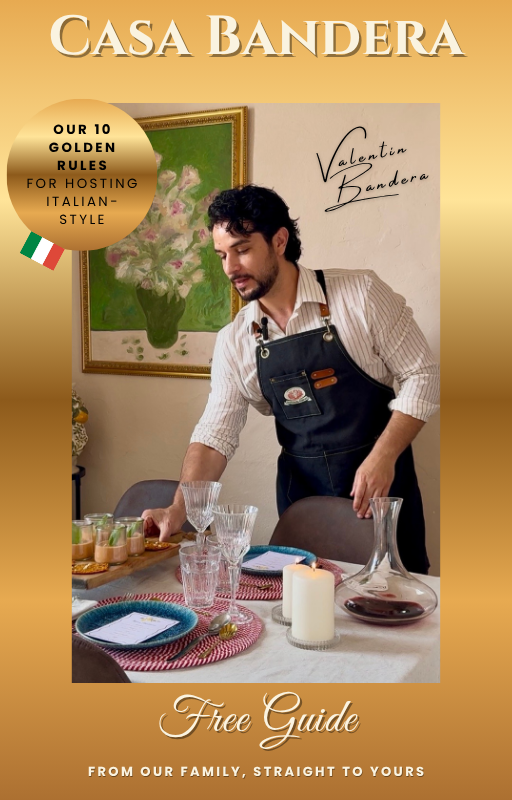

“In Bologna, I came to understand something essential: the best dinner parties aren't necessarily spontaneous. They're simply organized in such a way that no one notices the preparation behind them.
Behind an evening that seems to unfold effortlessly, there's often a thoughtful rhythm, a little forward planning, and a genuine desire to remain present for your guests.”
— Casa Bandera, from our Famiglia to yours
Table of Contents
Why a Well-Planned Timeline Is The Key to a Successful Italian Dinner
Some dinner parties have a way of making everything look effortless: guests are greeted with a smile, dishes arrive at just the right moment, and no one seems in a hurry to move on to the next course. This sense of ease doesn't necessarily come from exceptional cooking skills or an elaborate menu. More often than not, it comes down to thoughtful planning, long before the first guests ring the doorbell.
A successful dinner, then, begins well before the day itself. Choosing the right recipes, shopping in advance, identifying which preparations can be made ahead of time, and planning how each course will be served all help free up time when it matters most. The idea isn't to turn a dinner with friends into a military operation, but rather to make a few smart decisions so that everything doesn't come down to the last minute.
I particularly remember a dinner at some friends' home in Modena. Mae was chatting with the other guests, our little Rose was enjoying the lively atmosphere around the table, and the meal was unfolding at its own pace. Each course arrived without long interruptions, conversations flowed naturally, and no one seemed to be watching the clock. What stayed with me wasn't an especially elaborate presentation, but the way the evening left everyone free to enjoy being together.
It's also one of the principles that inspires me when it comes to the Art of Italian hospitality: prepare enough in advance so that you can let go once the evening begins. In the rest of this article, we'll explore how to plan an Italian dinner from start to finish with a simple timeline, from the preparations in the days leading up to it to the final details before your guests arrive.
The Italian Mindset: Simplicity and Thoughtful Planning

Italian meals are often associated with a certain spontaneity: a table full of people, dishes being passed around, lively conversations, and hours spent together over a meal. But this seemingly carefree atmosphere doesn't mean that nothing has been planned. Quite the opposite. Thoughtful preparation is often what makes it possible to create the warm, natural atmosphere we appreciate so much.
In Italy, as elsewhere, traditions vary from one region to another and from one family to the next. But one idea comes up time and again in the meals that have stayed with me: generosity and togetherness matter far more than trying to impress at all costs. The menu doesn't need to be endless, the table setting can remain understated, and the dishes don't have to compete in sophistication. What truly matters is the attention you give your guests and the quality of the time you share.
I often think back to lunches at Nonna's house. Mae would be laughing, Rose would be dropping pieces of bread on the floor, and the conversation would carry on around the table. Nothing had to be perfect for the meal to feel special. There was simply good food, a home full of life, and genuine care for everyone around the table. “Mangia, rilassati” — eat, relax. That little phrase captures the spirit I love to recreate whenever I host.
To bring this approach into your own home, the most important thing is to avoid getting caught up in an endless list of preparations. Three common mistakes can quickly make an evening more complicated than it needs to be: trying to serve too many dishes, choosing a recipe you've never tested before, or planning several preparations that all require your attention at the last minute. Before you know it, you'll be spending more time in the kitchen than enjoying your guests.
Ultimately, simplicity takes a little good judgment. A shorter menu built around recipes you know well and quality ingredients can create a far more enjoyable experience than an ambitious meal that's difficult to coordinate. Planning should always serve the pleasure of gathering around the table, never become another source of pressure. That's the kind of quiet confidence we'll put into practice with the timeline below.
The Perfect Timeline for Planning a Stress-Free Italian Dinner
2 Days to 1 Day Ahead: It All Starts Here
A successful Italian dinner is largely prepared in the days leading up to it. This is when you can make the essential decisions, divide up the tasks, and avoid finding yourself with a long to-do list on the day itself. A few well-chosen preparations are often enough to make the evening considerably more relaxed.
Start by putting together a short, well-balanced menu featuring dishes you're already familiar with. For a relaxed dinner with friends, a simple structure of one antipasto, a pasta course, and dessert makes an excellent starting point. It gives you a complete Italian meal without multiplying the preparations or creating unnecessary work in the kitchen. Naturally, you can adapt it to the number of guests, the season, and the occasion.
- An antipasto to share, partly prepared in advance
- A pasta dish with a sauce that can be made ahead of time
- A dessert that can comfortably wait in the refrigerator
Once your menu is settled, it's time to go grocery shopping. Put together a complete shopping list, checking the quantities you'll need and the ingredients you already have at home. Choose fresh, seasonal, high-quality ingredients: a handful of carefully selected products will often do more for your meal than a succession of elaborate recipes. Also, take the time to select an Italian wine that pairs well with your menu, along with a good olive oil that will naturally find its place on the table.
This attention to ingredients brings back memories of certain meals in Bologna, where a pasta dish made with good-quality ingredients was all it took to bring everyone together around the table. There was no need to do more: quality ingredients, a well-executed recipe, and the pleasure of sharing a meal already made all the difference.
Finally, use these two days to get ahead on any preparations that keep well. Tiramisu or panna cotta can generally be made the day before, while a sauce can be cooked in advance and stored properly until dinner. Just be sure to check the storage times and instructions for each recipe. On the day itself, you'll only need to focus on the final steps, particularly cooking the pasta and plating the dishes.
The goal is simple: move some of the work to the days before your dinner so you can save time and be fully present when your guests arrive. You're not just preparing a meal; you're also giving yourself the opportunity to enjoy it.
Free Guide: 10 Golden Rules for Hosting Italian-Style
The Morning of The Dinner: Getting Everything in Place
On the morning of your dinner party, the priority is to make sure everything is in place and take care of the final details without feeling overwhelmed. You've already chosen your menu, done the grocery shopping, and taken care of much of the preparation over the previous few days. Now it's time to make sure your home is ready to welcome your guests in the best possible setting.
Start by walking through your dining room and kitchen. Check that everyone will have a comfortable seat, that you have enough dinnerware, and that all the utensils you'll need for serving are ready. Take this opportunity to add the final decorative touches: a few candles, fresh flowers, or soft lighting can be all it takes to create a welcoming atmosphere without overcrowding the table.
- Seating capacity, dining table, and chairs checked
- Enough dinnerware, silverware, and glasses for everyone
- Clean tablecloth and cloth napkins ready
- Decorations in place: candles, flowers, or ambient lighting
- Kitchen utensils and serving accessories within easy reach
Once you've taken care of these checks, move on to the food preparation that can be completed ahead of time without compromising the quality of your dishes. You might, for example, finish chopping ingredients, wash your herbs and vegetables, prepare ingredients that will need to be assembled later, or gently reheat a sauce you've already made, depending on your recipes. It's also a good time to review cooking times and the order in which each dish needs to be prepared.
If you've spread the work across the two days leading up to your dinner party and the morning itself, most of the major tasks should already be behind you by lunchtime. The goal isn't to reach a specific percentage of completed preparations, but to minimize anything that might keep you in the kitchen when your guests arrive. The more you plan ahead, the more relaxed you'll feel as the evening begins.
One Hour Before: Time to Become The Host

This final hour deserves special attention. It's time to wrap up the preparations, but also to shift gears: you're no longer just the person preparing the meal. You're about to become the person welcoming everyone into your home. If you still have a long list of tasks to tackle at this point, it'll be difficult to fully enjoy those first moments with your guests.
Make sure the table is completely set and that everything you'll need throughout the meal is within easy reach. Take out any ingredients that need to come to room temperature, prepare the final elements of your antipasti, and set out the bread, water, and glasses. If you've chosen a wine that needs to be opened or allowed to breathe ahead of time, take care of that at the right moment, depending on the wine itself.
In the kitchen, make sure your sauces and other preparations are ready for their final touches, your pots and utensils are within reach, and you know exactly which steps are still left to complete. Pasta, for example, should be cooked just before serving, but everything around it should already be taken care of: water ready to heat, sauce close at hand, and serving dish within reach.
Mae often reminds me of something very true: “If you're still cooking when your guests arrive, you're already running behind.” Of course, some last-minute cooking is naturally part of the experience, and there's no need to have absolutely everything finished before your guests walk through the door. But the essential preparations should be far enough along for you to welcome everyone without having your mind entirely occupied by what's happening in the kitchen.
From this point on, give yourself a few minutes to catch your breath, get ready, and enjoy the atmosphere you've created. A drink in hand, warm lighting, and an organized kitchen: you're ready to welcome your guests. It's precisely this ability to be present that gives the evening its warm, spontaneous character.
Quick Checklist: A Stress-Free Italian Dinner Party
To make sure nothing gets overlooked, here's a recap of the main steps to follow. Use it as a simple roadmap while preparing for your dinner party. The idea is to keep an overview of everything without having to rush through tasks at the last minute.
Two Days to One Day Before
- Menu finalized and recipes selected (antipasto, pasta, and dessert)
- Grocery list checked and shopping completed
- Fresh ingredients, Italian wine, and olive oil ready
- Dessert prepared ahead of time whenever possible
- Sauce made and other preparations taken care of in advance
The Morning of The Dinner
- Dining table, chairs, and seating arrangements checked
- Dinnerware, silverware, glasses, and utensils ready
- Decorations and lighting in place
- Ingredients washed, chopped, or prepared according to the recipes
- Final kitchen checks completed
- Most of the preparations are already taken care of
One Hour Before
- Dining table completely set
- Bread, water, and glasses ready to serve
- Wine opened or decanted if needed
- Aperitivo and antipasti prepared or easy to finish
- Ingredients and utensils within reach for the final cooking steps
- No major preparations should still be keeping you in the kitchen
During Dinner
- Welcome your guests with a relaxed aperitivo
- Serve the antipasti and give everyone time to enjoy the conversation
- Let the meal unfold at its own pace, without rushing through the courses
- Finish each dish at the right moment while minimizing time away from the table
- Stay present and enjoy the evening with your guests
If you've followed these steps, you should be able to approach your dinner party with much greater peace of mind. Not everything will necessarily go exactly according to plan, and that's perfectly fine. A guest arriving a little early, a conversation that runs longer than expected, or a dish served a few minutes late are all part of the rhythm of a home.
The schedule isn't there to make the evening feel rigid or overly structured. It's there to give you enough freedom to enjoy the experience rather than feel constrained by all the preparations. Getting everything ready certainly matters, but it's only a means to an end: the real goal is to share a beautiful moment around the table.
During Dinner: Timing Makes All The Difference
An Italian dinner is about more than a succession of dishes served one after another. It unfolds gradually, through conversations, shared plates, and the moments that naturally develop around the table. The pace matters just as much as the food itself: it allows everyone to enjoy the meal without feeling as though they are following a carefully scheduled program.
Start by offering an aperitivo alongside a few antipasti to share. A Spritz, a glass of Prosecco, or a Negroni can set the tone for the evening, depending on your guests' preferences. To accompany these first drinks, prepare a selection of small bites: Taggiasca olives, breadsticks, coppa, mortadella, or scamorza cheese. Arranged on a beautiful wooden serving board, these Italian specialties make for a generous and welcoming introduction to the meal, without requiring much last-minute preparation.
Just be careful not to overdo this first course. Antipasti should whet your guests' appetites, not take the place of the rest of the meal. Give everyone time to settle in, chat, and enjoy this first moment together before moving on to the main course. You can then naturally gauge the pace of the evening and choose the right moment to serve the next dish.
I often think back to a dinner in Florence where the main course was served after about forty minutes. No one seemed impatient. Conversations were flowing, glasses were being refilled, and everyone was enjoying the moment. The meal had found its own rhythm without anyone needing to keep an eye on the clock. That's precisely what thoughtful planning makes possible: you can adapt the service to the atmosphere rather than constantly worrying about what comes next.
Dessert and, if you like, a small after-dinner drink can then extend the evening. A tiramisù served with coffee, a few sweet treats to share, or a glass of limoncello can bring a lovely finish to the meal. But there's no need to rush this final moment. Let the conversations linger, and take the time to enjoy your guests' company too.
Your role isn't to stick to a minute-by-minute schedule. It's about anticipating each stage, sensing when the time is right to serve, and preserving the convivial atmosphere of the evening. That's how you can host a stress-free dinner while remaining fully present around the table.
Putting Together a Simple and Irresistible Italian Menu

Choosing the menu is one of the most important decisions when planning a dinner party. It shapes much of your preparation, the time you'll spend in the kitchen, and the overall flow of the meal. Yet this is also where it's easy to get carried away: one extra recipe here, a more elaborate dish there, until you end up with a menu that's difficult to manage.
If you want to host in the true Italian spirit, it's better to focus on a well-balanced progression of dishes rather than trying to impress with sheer quantity. One approach is to take inspiration from the traditional Italian meal structure, built around antipasti, a primo, and a dolce. This provides a simple framework that you can adapt to the occasion, the season, and your guests' appetites.
- Antipasti: A few dishes to share, designed to whet the appetite and get the conversations started.
- Primo: The heart of the meal, often a pasta or rice dish, or another traditional Italian preparation.
- Dolce: A sweet finish to the meal, ideally prepared ahead of time.
For a dinner party at home, here's an example of a menu that brings together authentic Italian flavors and practical planning:
- Antipasti: A Sicilian caponata, served with some good rustic bread. It can be made ahead of time, allowing the flavors to develop even further.
- Primo: Spaghetti alla carbonara or amatriciana, prepared just before serving to preserve their perfect texture and creamy consistency.
- Dolce: A tiramisù, made the day before and kept refrigerated until dessert.
This menu has one particularly appealing advantage: each dish follows its own preparation schedule. The caponata and tiramisù can be made ahead, while the pasta is cooked just before serving. This means you won't have to juggle several complicated preparations at once, while still offering your guests a generous and well-balanced meal.
Of course, this structure isn't set in stone. You can add a second antipasto, replace the pasta with a risotto, or include an additional course for a special occasion. The key is to keep your menu cohesive and suited to your cooking skills and the time you have available. Your guests won't necessarily remember how many dishes you served, but they will remember the quality of the flavors and the pleasure of sharing them around the table.
The Host's Role: The Invisible Key to a Memorable Dinner

You may have planned a delicious menu, set a beautiful table, and carefully prepared every detail. Yet one essential ingredient is still missing for your dinner party to be a success: your presence. Because hosting isn't simply about serving good food or making sure everything runs smoothly. It's also about creating the conditions for an enjoyable experience, where everyone feels comfortable and naturally finds their place.
I often think back to a dinner in Modena, where our host's attitude left a particularly lasting impression on me. He was calm, attentive, and seemed to enjoy sharing the evening just as much as welcoming his guests. Nothing felt forced. Each course arrived at just the right moment, conversations flowed freely, and everyone around the table enjoyed the relaxed atmosphere.
After that dinner, Mae pointed out something that really stayed with me: we don't always remember exactly what we ate, but we remember very well the atmosphere and how we felt as guests. That observation captures one of the essential aspects of the Art of Italian hosting: the experience isn't based solely on what you serve, but also on the attention you give to the people gathered around your table.
You don't need to act like a chef managing a kitchen brigade or a server constantly watching over every little detail. Your role is to welcome people, make them feel at ease, and enjoy the evening yourself. A few simple habits can make all the difference:
- Spend as much time as possible with your guests rather than making endless trips back and forth to the kitchen.
- Plan the serving arrangements ahead of time so you don't have to keep interrupting conversations.
- Adapt the flow of the meal to the atmosphere and your guests' preferences.
- Accept that not everything needs to go perfectly: a lively dinner doesn't need to run like clockwork.
Your attitude often sets the tone for the entire evening. When you're relaxed and present, your guests are naturally more likely to feel at ease too. Perhaps that's one of the most valuable lessons of the Art of Italian hosting: knowing how to prepare everything with care, then leaving enough room for spontaneity so that the moment belongs to everyone.
FAQ – Frequently Asked Questions
The best way to reduce stress is to spread your preparations over several days. Choose a menu you're comfortable making, do your grocery shopping ahead of time, and prepare anything you can the day before. On the day of the dinner, leave only the final cooking and finishing touches. This way, you can welcome your guests without spending the entire evening in the kitchen.
For a family dinner, focus on generous dishes that are easy to share and suit your guests' tastes. A menu made up of a few complementary dishes is often a better choice than a succession of complicated recipes. Remember to account for any dietary restrictions and prepare some of the dishes in advance.
Plan the main stages of the meal: aperitivo, antipasti, main course, and dessert. Account for preparation and cooking times, but avoid imposing an overly strict schedule for each course. Good timing should allow the meal to unfold naturally while leaving plenty of room for conversation.
Plan your menu, grocery shopping, drinks, table setting, and food preparations. Also make sure you have enough dinnerware, glasses, and kitchen utensils. A checklist divided into two days before, the day before, the morning of, and the hour before your guests arrive will help you remember everything.
Two days ahead, finalize your menu and do the grocery shopping. The day before, prepare dessert and any sauces that can be made in advance. On the morning of the dinner, check the table setting, dinnerware, and ingredients. An hour before your guests arrive, finish the last preparations and organize your kitchen so that all you have left to do during the meal is the final cooking and finishing touches.
Conclusion: Hosting an Italian Dinner Is About Creating a Moment
Hosting an Italian dinner from start to finish isn't about controlling every detail or striving for a perfectly orchestrated evening. It's about finding the right balance between preparation, simplicity, and being present. A well-planned menu, a few tasks taken care of in advance, and a clear idea of how the evening will unfold allow you to fully enjoy what really matters: the pleasure of welcoming others into your home.
Remember that organization is a means to an end, not the goal itself. It should free up your time, not become another source of pressure. You can plan the main stages of the meal while still allowing conversations to linger, guests to help themselves to another serving, and the evening to take an unexpected turn.
Ultimately, the most beautiful memories don't necessarily come from an exceptional menu or spectacular table decorations. They're made around a table where everyone feels at home, where conversations are genuine, and where the host takes the time to enjoy their guests too. That's the atmosphere I love about the Art of Italian hosting: simple generosity, genuine thoughtfulness, and the joy of sharing a moment that makes everyone look forward to doing it all over again.
Also read:
What to Cook When You Have Guests (15 Easy Ideas)
Create an Unforgettable Italian Experience at Home
The Art of Italian Hosting: The Complete Guide to Creating Unforgettable Dinner Parties

Free Guide: 10 Golden Rules for Hosting Italian-Style


Let’s Talk Together!